
Read the latest issue of Dairy Market Drivers, a bi-weekly report from IDFA partner Ever.Ag. Dairy Market Drivers features spotlight data, key policy updates, and a one-minute video that covers timely topics for the dairy industry.
Dairy Market Drivers: Consumer Demand for Protein; Gas Prices Rising; and Butter in a Minute!
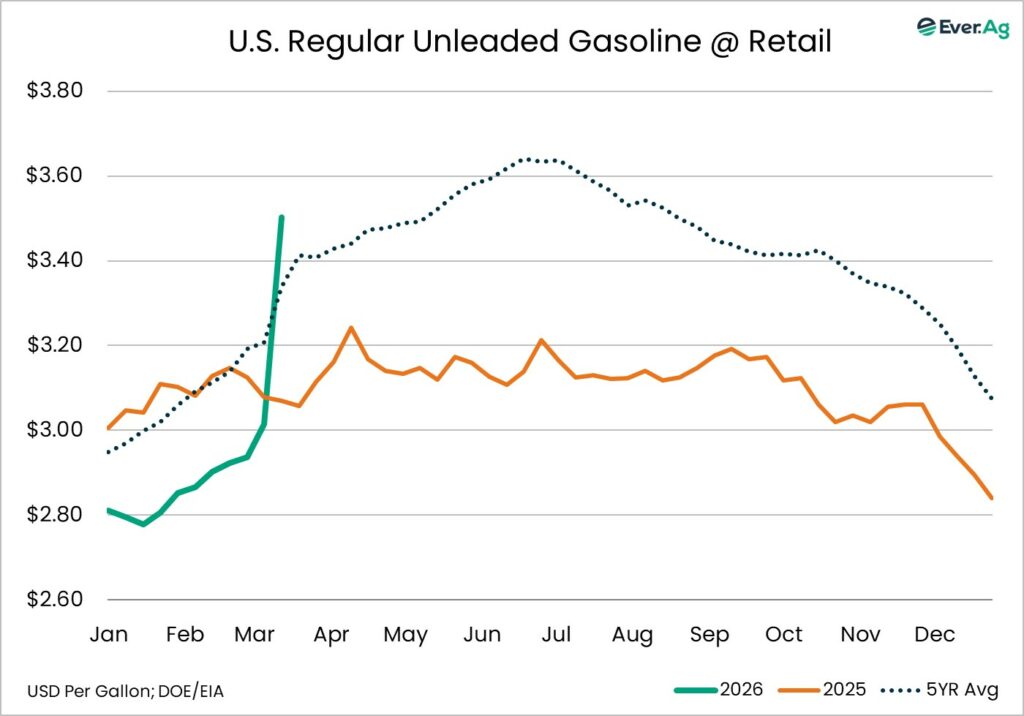
Quick Bites: Gas Prices on the Rise
- Consumers faced rising prices for many goods and services last year, but gasoline was not one of them. In fact, 2025 was one of the quietest and most stable years for gasoline in nearly two decades, with an average price of $3.10 per gallon. According to GasBuddy, the U.S. national average gasoline price spent the year within a 50.2-cent range, the third-smallest annual range in the past 20 years.
- But that quickly changed when military conflict in the Middle East sent crude oil prices skyward in February. Diesel and gasoline followed suit, with US gasoline jumping from the $2.90s last month to last week’s average of $3.50 per gallon.
- With more dollars being spent on gas, consumers will have less in their budgets for discretionary spending. In the past, this hurt spending in categories like restaurants, which would be negative for dairy demand.
- Rising oil prices are also hitting farmers as we head into Spring planting season. Not only is diesel fuel more expensive, but conflict in the Middle East also affects fertilizer prices in multiple ways.
- Natural gas is a main feedstock for some fertilizers, so rising prices impact those production costs. The Middle East is also a significant fertilizer production hub, and limited travel through the Strait of Hormuz may delay transport of needed fertilizers.
- Fertilizer values are up across the board for U.S. farmers. As of early March, USDA reported that urea and potash prices were 8% higher than a year ago. Ammonium sulfate costs 15% more than last Spring, while MAP and DAP are up 11% and 13% year-over-year, respectively. Anhydrous ammonia soared $60 per ton from last month and is 20% higher than last March. Liquid nitrogen 28% jumped 30% compared to the March 2025 price.
- The U.S. is one of the world’s top fertilizer producers, but imports are needed to meet demand. While much of this Spring’s fertilizer needs are likely booked and en route, additional purchases may be difficult to obtain and at a hefty price tag.
Today’s Special
- Dairy brands are leaning into consumers’ demand for protein. While dairy products already boast a healthy dose of protein, innovations in the dairy space allow some products to push protein content higher.
- Cheese is a good source of protein, with around 38% of Americans saying they regularly turn to it for this nutrient. Varieties like cheddar and mozzarella serve up 6-7 grams of protein per ounce, while harder cheeses such as Parmesan can provide around 10 grams per ounce due to lower moisture and concentrated nutrients.
- Cottage cheese is one of the most protein-dense cheeses, with a half-cup serving containing roughly 11-12 grams. Thanks in part to social media buzz, this nutrient density has drawn in consumers of all ages to a form of cheese that was not previously in high demand.
- Some manufacturers are reformulating products to add more protein and other health benefits. For example, Baybel introduced a new cheese snack that packs 5 grams of protein, probiotics and only 50 calories.
- Even more indulgent snack foods are sneaking in some extra protein. New Doritos Protein chips, including their popular nacho cheese flavor, will be released later this year.
- Each one-ounce serving contains 10 grams of protein, and a single-serve bag will feature 17 grams. Other companies are highlighting protein levels clearly on the packaging, helping protein-focused consumers recognize dairy as a strong source of the nutrient.