
Read the latest issue of Dairy Market Drivers, a bi-weekly report from IDFA partner EA Risk. Dairy Market Drivers features spotlight data, key policy updates, and a one-minute video that covers timely topics for the dairy industry.
Dairy Market Drivers: Fluid Milk Growth; Grain Market Outlook; and the Job Market in a Minute!
Quick Bites: Fluid Milk Sales Steady Through July
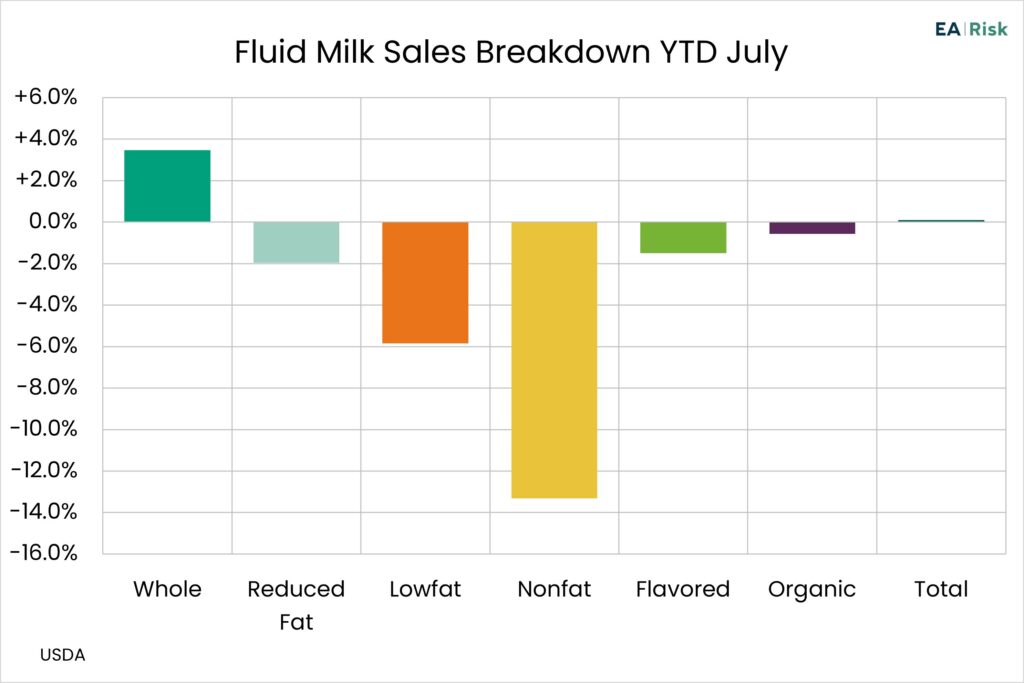
- Fluid milk sales took a step higher in July, bringing year-to-date sales up 0.1% versus the same period in 2025. That marked the first time since late 2024 that year-to-date sales have been above prior-year levels for two consecutive months.
- Riding the wave of demand for healthy fats, whole milk was the clear bright spot, with year-to-date sales up 3.5% year-over-year. It outpaced the other major conventional milk categories, continuing the shift toward higher-fat milk that’s been building in recent years. And there could be another tailwind ahead, as whole milk returned to federal school meal programs this year after being largely absent for nearly 15 years.
- Lower-fat varieties are having a tougher year. Through July, reduced-fat sales were down 1.9%, lowfat dropped 5.8% and nonfat sank 13.3% – the steepest decline in the categories shown. The numbers fit with what’s happening beyond the dairy case, with federal dietary guidance and school-meal policy shifting to make room for full-fat dairy again.
- Organic milk also remained under pressure overall. Total organic milk declined 0.6% through July, though organic whole milk continued to stand out, rising 4.2%. Organic continues to have appeal for some health-conscious shoppers. Meanwhile, flavored milk could find opportunities as protein-forward dairy beverages attract more attention from consumers.
Today’s Special
- Harvest is getting underway across the country. As corn and soybeans start to come off the fields, will realized yields match expectations?
- Last week, when USDA released updated yield and production forecasts in its September World Agricultural Supply and Demand Estimates report, corn yield took a 2.2-bushel haircut from the August estimate and declined to 178.5 bushels per acre. Total corn production was also lowered from the August report to 15.800 billion bushels.
- No doubt, this would still be a historically good-sized crop, even though it will fall short of last year’s record production. But U.S. corn ending stocks are shrinking, and so are global inventories. The chance of a smaller-than-expected crop and tighter supplies world-wide are putting some pressure under corn prices.
- Meanwhile, USDA held soybean yield and production fairly steady in its September estimates. Yield predictions sit at 52.7 bushels per acre, while anticipated production is 4.520 billion bushels- both of which would surpass 2025 levels.
- After a hot, dry Summer in some growing regions, market analysts kept a close eye on crop conditions. The most recent reports from the field, however, put both corn and soybeans close to the five-year average in terms of crop ratings.
- Once out of the field, shipping harvested crops will be more complicated and expensive this year. Railroads run on diesel, which is at all-time-high prices over $6 per gallon. Over the past year, shipping surcharges for grains have more than doubled. Those costs are usually passed on to farmers and buyers.
- As the U.S. growing season nears completion, attention will turn to South America. The world will need abundant production out of South America to help fill global needs. But the looming super El Niño threatens to bring varying weather conditions to the continent.
- In parts of Argentina and Southern Brazil, expectations for above-normal rainfall may boost corn and soybean production. But flooding in some areas could damage crops, and excess humidity may increase the risk of fungal disease. On the other hand, in Brazil’s Mato Grosso region, the potential for drought stands to reduce output from the country’s top corn and soybean producer. Less production from South America means tighter global inventories and has the potential to raise grain prices around the world.